Power steering fluid in bilge?

Toddavid

Petty Officer 2nd Class
Joined
Sep 8, 2012
Messages
188
2014 Chap with VP V8-380-CD.

Checked on the boat at my marina warehouse and found an ounce or so of a thin reddish oil in the bilge below the engine.

I do all my own winterizing and it certainly wasn’t there when I laid her up back in October.

Steering fluid reservoir was a little low, but not empty.

Winter was brutal, coldest in years, with multiple single digit temp days.

Can’t see any drips underneath the engine using a borescope.

What are the chances a rubber line shrank in the extreme cold and let out some fluid at a connection?

Won’t be able to fire her up for another week when the warehouse is cleared out.
 

Chris1956

Supreme Mariner
Joined
Mar 25, 2004
Messages
28,680
Power steering hoses do leak, usually at the crimped ends. I had to replace them on my Mer cruiser after the crimps on the ends rusted out.
 

Chris1956

Supreme Mariner
Joined
Mar 25, 2004
Messages
28,680
My neighbor's mercruiser PS cooler rotted out and leaked all the fluid overboard. The boat was impossible to turn at cruise speed. We had go to idle to turn the wheel.
 

MarineSp

Cadet
Joined
Apr 5, 2026
Messages
8
Todd, given the brutal cold you described, I'd also check the fittings where the hoses connect to the helm and the ram – those can loosen slightly with freeze/thaw cycles. Since you can't start it yet, it might be worth topping off the reservoir and marking the level so you can track if it's still losing fluid. When you do fire her up, have someone turn the wheel lock to lock while you watch underneath – that's usually the quickest way to spot the source
 

Lou C

Supreme Mariner
Joined
Nov 10, 2002
Messages
13,972
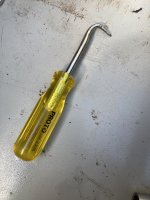
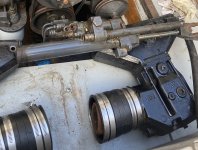
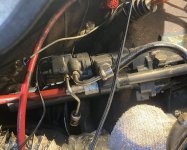
Agreed on all these possible leak sources. When you can start it up and cycle the steering back and forth, you'll be able to tell better. Hopefully it's not the power steering actuator. I did that job on my 1988 OMC Cobra and it's not a fun job. Volvo and OMC use these cotter pins to retain the bolts that hold the unit to the transom mount and THEY DIDN'T WANT TO COME OUT. It was a multi-day struggle to get them to move without breaking them. Cotter pin removal tool is your friend. I was able to find a good used unit on ebay. On these and older Merc units (they are the same Bendix style actuator) you can replace the seals in the actuator, it is very similar to the P/S used on unibody Fords and Corvettes back in the '60s and '70s. Then the design changed to a more modern one in '89/90 or so, which some people have been able to rebuild depending on what seals leaked. But you have to find your leak first.
If the P/S cooler froze it could be that too!
Cotter pin removal tool.jpgsteerng actuator removal.jpg
had to remove the exhaust on both sides after removing the rear seats for access

steering actuator intalled.jpgsteering actuator intalled.jpg
 

Scott Danforth

Grumpy Vintage Moderator still playing with boats
Staff member
Joined
Jul 23, 2011
Messages
52,313
Could be a bad return line
Could be a bad pressure line
Could be a bad clamp
Could be a bad reservoir
Could be a leaking actuator
Could be a leaking pump seal
Could be a leaking PS cooler

You now have to clean the bilge, then with the motor on the hose, run it AND LOOK for the leak.

Then go from there with the repair

Explain how you "winterized" it on your own.

Hopefully you didn't try to draw AF thru the system
 

Toddavid

Petty Officer 2nd Class
Joined
Sep 8, 2012
Messages
188
Could be a bad return line
Could be a bad pressure line
Could be a bad clamp
Could be a bad reservoir
Could be a leaking actuator
Could be a leaking pump seal
Could be a leaking PS cooler

You now have to clean the bilge, then with the motor on the hose, run it AND LOOK for the leak.

Then go from there with the repair

Explain how you "winterized" it on your own.

Hopefully you didn't try to draw AF thru the system
I winterized it the same way as I’ve done for the last 10 years of ownership.

It’s closed cooling, so I hook my 5 gallon pink stuff reservoir to the flush port, elevate the reservoir, start the engine and watch 4 gallons of pink stuff get sucked into the engine raw water cooling system and get expelled via the outdrive exhaust.

I then crack open the bottom of the main heat exchanger and let it drain into the bilge just to make sure full circulation.

Power steering cooler: is that raw water or coolant cooled on a closed cooled system?
 

Scott Danforth

Grumpy Vintage Moderator still playing with boats
Staff member
Joined
Jul 23, 2011
Messages
52,313
I winterized it the same way as I’ve done for the last 10 years of ownership.

It’s closed cooling, so I hook my 5 gallon pink stuff reservoir to the flush port,
suggest draining prior to using the block-buster kits. Volvo Pentas only close cool the block and heads, not the intake. so unless you sample what is in the manifolds and hoses with a refractometer to ensure a -40F protection, you can still freeze

Power steering cooler: is that raw water or coolant cooled on a closed cooled system?
Power steering cooler is between teh pickup and the raw water pump on the crank
 

Toddavid

Petty Officer 2nd Class
Joined
Sep 8, 2012
Messages
188
suggest draining prior to using the block-buster kits. Volvo Pentas only close cool the block and heads, not the intake. so unless you sample what is in the manifolds and hoses with a refractometer to ensure a -40F protection, you can still freeze


Power steering cooler is between teh pickup and the raw water pump on the crank

Got it.

I suspect a popped power steering cooler.

We’ll find out tomorrow when I get to fire her up.
 

Toddavid

Petty Officer 2nd Class
Joined
Sep 8, 2012
Messages
188
Here’s a related question: why is the fluid red? The fluid in my reservoir and in the VP OE pint I bought are both yellowish/clear.

I see that the power steering actuator (behind the engine) is a typical failure for these years. I saw a post on Facebook where someone had red fluid in the bilge and it was their actuator seals that had failed, despite their power steering reservoir having the clear/yellow fluid.

Does the actuator run on a dual circuit, where one of its internal pressure circuits uses a red colored fluid, separate from the pump circuit?
 

Scott Danforth

Grumpy Vintage Moderator still playing with boats
Staff member
Joined
Jul 23, 2011
Messages
52,313
OK, I'll bite. How does one repair a P/S cooler?
All PS coolers are is glorified plumbing parts. It's soldered together. Unsolder the end bells, repair the tube sheet to shell joint or the tube sheet to tube joint. Re-solder the end bells, pressure test, paint black

No difference from repairing a brass radiator
 

Lou C

Supreme Mariner
Joined
Nov 10, 2002
Messages
13,972
Here’s a related question: why is the fluid red? The fluid in my reservoir and in the VP OE pint I bought are both yellowish/clear.

I see that the power steering actuator (behind the engine) is a typical failure for these years. I saw a post on Facebook where someone had red fluid in the bilge and it was their actuator seals that had failed, despite their power steering reservoir having the clear/yellow fluid.

Does the actuator run on a dual circuit, where one of its internal pressure circuits uses a red colored fluid, separate from the pump circuit?
Have you owned the boat since new? It's possible that someone mixed different fluids. I always used Dexron in mine. I know Volvo loves their proprietary fluids $$$. Only one fluid path in the system, follow the hoses from the pump on the engine to the actuator which will be behind the starboard side exhaust manifold. Get a bright LED flashlight and look down below the rubber exhaust hoses on that side, if the actuator is leaking you'll probably see it there. Mine leaked for a few years before I got round to replacing it, one day when the auto bilge pump went on, what came out looked like a strawberry milkshake lol, so I knew it was time. As I said above, if this is your problem and you choose to do it yourself, take it slow, it is a tough job on many I/O boats because of lousy access to anything on the rear of the engine.
 

Toddavid

Petty Officer 2nd Class
Joined
Sep 8, 2012
Messages
188
Well, chalk up another “unsolved mystery” in my boating career.

Went to the marina today, cleaned the bilge spotless, checked power steering fluid, hooked up the garden hose to the flush port, and fired up the engine.

Ran her up to temp, cycled the steering wheel left and right a few dozen times, ran drive uncoupled to about 1500 rpms, heard the pump moan a little, topped off the fluid, no more moaning, still a clean bilge.

Looked all over and found no puddling anywhere on the engine, no oily residue on the actuator rams (I’m lucky to have easy access to it), could not locate the power steering cooler after feeling and searching everywhere (must be buried underneath the engine somewhere).

At that time I felt bold enough to sea trial her. Ran her hard for 20 minutes, checking the bilge regularly. All clean.

I’m going to assume rubber hose shrinkage at a slip joint, due to the extreme cold. Same issue apparently plagues the big forklifts at the marina when we have a brutal winter.

I’ll carry some stainless worm clamps with me in case it’s a loose connection that finally reveals itself. OE clamps are the one time use style.

🤷🏻‍♂️

I’ll update if anything changes.

Thanks to all for the suggestions, either way.
 
Top