




iboats.com
Recruit
- Joined
- Apr 5, 2011
- Messages
- 4

About 1960 Kart racing was hot rodding and open wheel racing in miniature. I had been racing for a few years with pretty regular success, but the availability of more powerful engines designed specifically for kart racing and more refined chassis were pricing me way out of the market. A Navy "white hat" raising three children didn't have enough money to spend to be competitive by buying the "latest thing". The hot rodding spirit of innovation seemed the only way, or at least the best way, to stay in the front ranks.
I had been racing a Bug brand kart that I had been given as a wreck with repaired or rebuilt Power Products (Tecumseh) chainsaw engines from Sears' David Bradley 5G saws. I acquired those engines as scrap from the Sears chainsaw repair facility where they had been replaced by new short blocks or scrapped completely.
My cash investment was minimal and had to stay that way. I needed a new strategy.
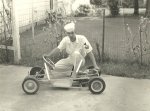
I had one advantage going for me. My competitors usually outweighed me by 20 to 50 pounds. That was a huge advantage in a racing kart, but my disadvantages were great.
Disadvantages? My engines were 4.7cid in a class that was limited to 6.1cid or less, they were cross scavenged in competition with loop charged engines and they were tuned to peak at 3600rpm.
In looking into the strategies of successful sports car and F1 racers I settled on the philosophy of Colin Chapman of Lotus: Add lightness and use small, high revving engines.
First step: Build the lightest legal chassis possible. I used up several pads of graph paper before I thought I had a winner. I designed a space frame of riveted aluminum 3/4"x 3/4" angle and aluminum sheet. It had a 40" wheelbase (minimum allowed) and only a few steel components. I set the engine in front of the rear (live) axle and behind the driver. It took about 60 hours to build, with a few modifications in midstream.
Next, I needed to convert my strong little chainsaw engine into a high revving, high performance screamer. I had plenty of scrap short blocks to experiment on.
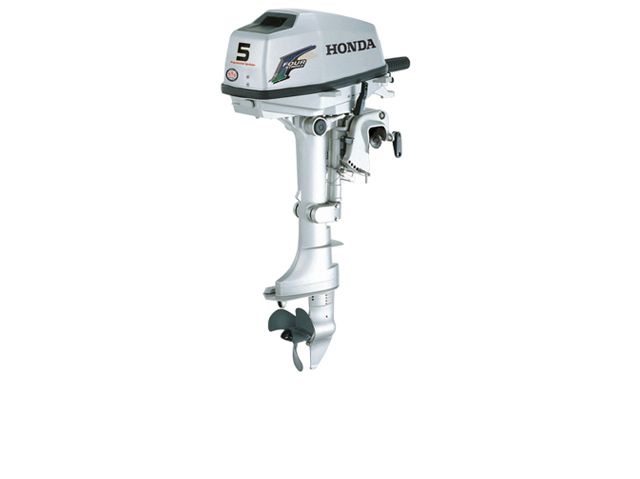
I knew that Eska used the same 4.7cid block on several outboards, so I investigated how they tuned them for as much as 7HP, vs. the 5HP the chainsaw version made. I found that they used variable timing on the ignition and a float style carb with a larger venturi. I didn't like the idea of the float style carb because it required a gravity feed fuel supply, but I found a larger venturi (3/4") diaphragm carb from a larger chainsaw that seemed to fit, and I acquired a (scrap) variable timing magneto from a scrapped Eska outboard.
Then I needed to address breathing, scavenging, port timing and compression ratio.
The stock engine used four tiny reeds. I cast (from polyester) an adapter to use the pyramid reeds from a larger Homelite chainsaw. They flowed more than twice what the stock reeds did.
To improve the pumping efficiency of the crankcase I filled wasted space with Plastic Aluminum. I have no idea if this made any difference because I tested several modifications at a time and couldn't separate results by each individual change.
I changed the piston to one with a modest dome on the exhaust side (from a later model) to increase compression ratio. I also removed about .040" from the base of the cylinder.
Shaving the base of the cylinder changed port timing. I raised, enlarged and squared the ports (intake and exhaust) to match the timing of an O&R model plane engine that turned about 10Krpm.
Those are the mods that survived in the final engine. Many others failed or blew the engine up. If I had a dynamometer I could have done a lot better. I used lap times to evaluate the mods.
Finally, I addressed fuel. The first step was to enlarge the jets in the carb to accept methanol based fuel. My first experiments used methanol with castor oil at 8:1 and about 8oz per gallon of ethyl ether. I got my best results from a half gallon of methanol with a quart of Fox Hi-nitro glow plug fuel added. The glow plug fuel used a synthetic oil at a hi ratio. . .I don't remember what that ratio was.
Ready to race, Brutus Minimus weighed 40lb. and went like stink.
Over time she evolved. The chassis was weak so I gusseted her with aluminum plate. Then I upgraded engines, first to a 6.1cid looper engine, then, finally to twin 8.2cid Power Products engines. That was a truly brutal package that presented problems with controlling wheel spin. It finally twisted the 3/4" steel live axle like a pretzel
Shortly thereafter exotic fuels were banned. Detuned for gasoline and 2 stroke oil they were not so competitive.
I suspect that many of the mods I did would be possible on air cooled, one cylinder outboards at the risk of low reliability and life span.
(JB Cornwell writes from "The Hideout" in Whitt, TX, and is also an expert moderator, instructor, and fountain-of-knowledge in the iboats.com Boating Forums, where he may occasionally share a yarn of his own.)