




Check/Fix/Replace Starter Motor 1996 50hp

Chris1956

Supreme Mariner
Joined
Mar 25, 2004
Messages
28,612
You can usually test the spark timing with all but one of the spark plugs removed, and a timing light on the remaining spark plug, in the top cylinder.

Joe Reeves was an iBoats member who worked at OMC for a long time and published a timing procedure for OMC products that doesn't require their specialized equipment. You might search for it here under "Joe Reeves method".
 

saltchuckmatt

Captain
Joined
Jul 19, 2019
Messages
3,129
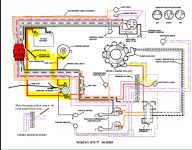
Thanks. It cranks when the spark is off (I wouldn't say well). Voltage drops about 3.5V. Cannot crank when circuit is set to spark. I'd like to test the spark timing, can I do this without cranking using the starter motor. Is it time to do electrical tests on the wiring, from ignition switch to solenoid?
Without going back through the posts, and assuming this is a remote motor, have you removed the control box plug from the motor and then try testing the starting stuff back at the motor. Usually I jump the solenoid and at that point the kill circuit will somewhat be removed from the system. At least it'll tell you if it's in the control box or back at the motor. Racer one and Chris know a lot so maybe it's just what they suggest but kill circuit is a known problem.
 

janul15

Petty Officer 2nd Class
Joined
Feb 15, 2020
Messages
100
Before doing other things, I want to check the current draw when powering up the starter motor on the bench. I'm taking delivery of a clamp on ammeter tomorrow. Chris 1956 suggests the current draw should be less than 200 Amps. Does that value sound right for a bench test? I can post my findings tomorrow night, or Saturday, if the test should only be done on the boat.
 

Crosbyman

Vice Admiral
Joined
Nov 5, 2006
Messages
5,988
I don't really know where you are at here but rightly or wrongly I can't see how the ignition /kill circuitry would contribute to the starter problem unless somehow it contributes such a high amperage drain worthhy of smoking up the place being low drain elements to begin with.

That said and not to oversimplify as an occasional greenlighter.... if it seems there are no mechanical issues with the engine innards, soexternally your left with few possibilities
  • bad starter
  • bad power circuitry
  • bad battery
Bad power circuitry seems the likely suspect, ohms law and and an inexpensive IR gun are is your friends...incl your fingers ! .

Before doing a series of cranking test and after cleaning all electrical junction points incl. cable crimps..... properly install a voltmeter at subsequent points and note the voltage before (up to the solenoid) and during while cranking.

Each point showing lesser and lesser volts indicates a resistance to current flow and is likely to generate heat (P=VxI across the resistive junction) which your fingers or an IR gun can sense.
main points to check...
  1. across battery posts to establish a referrence value before/ while cranking
  2. across solenoid "IN" post and battery B- (before and during cranking)
  3. across solenoid "OUT" post and battery B- (before and during cranking)
  4. across starter "IN" post and battery B- (during cranking)
tell us what you found
 

dingbat

Supreme Mariner
Joined
Nov 20, 2001
Messages
17,003
Continuity test only tells you if the motor is shorted to ground. Tells you absolutely nothing about the integrity of the windings themselves.
 
Top