


Engine backfiring through throttle body when trying to accelerate

badrano

Petty Officer 1st Class
Joined
Aug 7, 2018
Messages
394
The engine was experiencing some backfiring through the throttle body when trying to accelerate and at times sounded like it wanted to stall out at idle. I replaced the tstat on Friday and fired it up, got it up to temp, cracked the throttle a little bit...maybe 800-1000 rpms for a few seconds just to get a little more water pressure flowing through the housing to check for leaks.....it ran fine. Today, take it out on the water....poof. Get home and on muffs, it behaved as described below.

Boat running on muffs, here's what I've captured for data from Diacom and other tools
- Fuel pressure around 43 psi when key is turned on
- Fuel pressure runs around 38 psi at idle
- RPM roughly 600 +/- a bit
- MAP sensor around 8.7 at idle
- Spark advance varies around 4 to 14 deg at idle
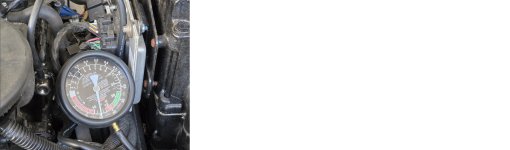
- Vac gauge hovers/fluctuates a little in the 30 +/- a few. I did a reading one time last year when everything was running good and saw the same behavior
- From Diacom, with the throttle cracked around 3% (not in gear), it starts to surge
-> MAP fluctuates between 11.61 and 7.81
-> RPM fluctuates between 430 to 795
-> Spark advance drops to around 4 deg during the surging
-> Vac gauge fluctuates between 32 and 17
-> No noticeable change in fuel pressure

Thoughts?
 

alldodge

Moderator
Staff member
Joined
Mar 8, 2009
Messages
44,059
Have you replaced the distributor cap and rotor?

Are your Vac gauge readings in kPa?
 

badrano

Petty Officer 1st Class
Joined
Aug 7, 2018
Messages
394
Have you replaced the distributor cap and rotor?

Are your Vac gauge readings in kPa?
My bad on the vac readings...... those numbers I posted were in cmHg.
To revise them....
At idle around 12 inHg.
When surging, 7 to 12.5 in Hg.

That is one thing I didn't check yet when I got home last night. But cap, rotor, wires were replaced in 2023, plugs replaced last season after resolving the rich condition.

Vac gauge.jpg
 

alldodge

Moderator
Staff member
Joined
Mar 8, 2009
Messages
44,059
The caps on these motors may last a long time and others have a very short life. You can't look at one and see that it's bad. Search the net and you'll find they go out without warning. Yours may be fine but only one way to find out

If cap is good I would do a compression test
 

Lou C

Supreme Mariner
Joined
Nov 10, 2002
Messages
14,053
Might be a vacuum leak with the surging idle and low vacuum test results; should be higher than 12” of mercury.
 

badrano

Petty Officer 1st Class
Joined
Aug 7, 2018
Messages
394
Might be a vacuum leak with the surging idle and low vacuum test results; should be higher than 12” of mercury.
It's not surging at idle, only when I add a little throttle. Otherwise the engine sounds/feels normal when at idle.

Last year when I addressed my fuel pressure issue, I replaced all the vacuum lines. My vac readings came from inserting the vac gauge right at the port on the intake manifold before all the other components that need vacuum. Are you saying that if I have vacuum leak, it's not due to the vacuum lines I replaced? Is this where allDodge is recommending a compression test if the cap/rotor is not the issue? Just to throw this out....engine only has 350 some hrs on it.

For the 12" of vacuum, I noted this same reading in a post a couple years back and some of the answers I got was that marine engines don't pull the same level of vac as car engines do.
 
Last edited:

badrano

Petty Officer 1st Class
Joined
Aug 7, 2018
Messages
394
The caps on these motors may last a long time and others have a very short life. You can't look at one and see that it's bad. Search the net and you'll find they go out without warning. Yours may be fine but only one way to find out

If cap is good I would do a compression test
Just found a post where some folks treat cap/rotor like the water impellar....replace it every couple years.
 

alldodge

Moderator
Staff member
Joined
Mar 8, 2009
Messages
44,059
Back firing through intake is caused by spark happening at wrong time, intake valve not fully closed.

It's suggested to keep a spare cap in the boat and wait for issues to start that are unexplained easy. Swap out and if it's fixed all good, if not dig further
 

badrano

Petty Officer 1st Class
Joined
Aug 7, 2018
Messages
394
Just an off the cuff question.....in the case of my engine with a distributor, how does the ECM advance or retard timing when you have a fixed rotor rotating around making contact with the "points" on the dist cap? I'd think you couldn't advance or retard too much otherwise the rotor won't be in contact with a given "point" on the cap?
 

alldodge

Moderator
Staff member
Joined
Mar 8, 2009
Messages
44,059
Unable to say exactly but controlled by the ECM. The contact width of the rotor and width on cap provides a certain amount of degrees
 

Scott Danforth

Grumpy Vintage Moderator still playing with boats
Staff member
Joined
Jul 23, 2011
Messages
52,464
ECM reads the pulse from the trigger, and then fires the coil. It can vary the timing +25 degrees to -15 degrees
 

badrano

Petty Officer 1st Class
Joined
Aug 7, 2018
Messages
394
The update.....
Put new cap and rotor on....old ones didn't really look bad.....either way, problem still exists.

Starting with a cold engine, it died twice but finally stayed running but sounded rough with an irregular rpm. As it warmed up a little bit, started to sound better even though it wasn't yet at operating temp.....then tried to give a little throttle and it stumbled but recovered but still sounded rough.

allDodge...I'll take your recommendation and do a compression test. I've been meaning to do one anyways to get a baseline.

Still blows my mind how everything worked fine 2 days prior. The only other variable at play here is I topped the gas tank off prior to launch. Don't know if I got crap gas. I would think if I sucked something through and caught by the filter, the fuel pressure would be low while running.
 

alldodge

Moderator
Staff member
Joined
Mar 8, 2009
Messages
44,059
Biggest issue with the motors is you really need a scanner to check codes. I might be something like a loose connection or bad crank position sensor but without one it's playing a game of darts
 

nola mike

Vice Admiral
Joined
Apr 22, 2009
Messages
5,844
Biggest issue with the motors is you really need a scanner to check codes. I might be something like a loose connection or bad crank position sensor but without one it's playing a game of darts
He's got diacom data above....
As mentioned, I'd definitely start with a compression test to make sure you don't have a stuck valve
 

Lou C

Supreme Mariner
Joined
Nov 10, 2002
Messages
14,053
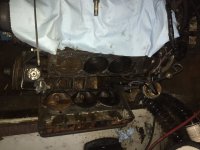
Thinking back, a back fire through the carb was my prelude to the blown head gaskets I had about 10 years ago. I remember the first start up of '16 it did that, and I though that was odd, but then it didn't do it again. The boat ran fine from June to August and when we got back from vacation (it sat on the mooring for 10 days) it didn't want to start easily like it usually does. When it did finally start, it ran rough till it warmed up. A few days later I found the water in 2 cyls, not enough to hydrolock but enough to make valves stick. When I took the heads off, I could plainly see it. So an intake valve was hanging open a bit and it backfired through the carb. A hot compression test didn't show that because it wasn't sticking once it warmed up. Just on a hunch I cranked it with all the plugs out and sure enough, a small stream came out of #2 and just a tiny mist out of #1. At the time I thought it could have been the manifolds but when I pulled the boat out I tested them and they weren't leaking.
I think with marine engines with wet exhaust it's more common to have sticking exhaust valves but I think you can have either or both.
This is what is good about diagnostic testing and some of the tools we have today like endoscopic cameras, they are very useful for figuring out things like that.
You can see the corrosion in this pic...
4.3 port cyl head removal.JPG
 

badrano

Petty Officer 1st Class
Joined
Aug 7, 2018
Messages
394
Biggest issue with the motors is you really need a scanner to check codes. I might be something like a loose connection or bad crank position sensor but without one it's playing a game of darts
Monday was kind of a freaky day if you're a superstitious person. After dropping the boat in the water and went to start it, the fuel gauge wasn't working...it was working on Friday. I disconnected/re-connected the connector at the tank and then all was fine. While in the channel heading out, I glanced at the chartplotter and noticed the bay water temp was 66.6 deg. Then once out of the no wake zone, gave it some throttle and the rest is history. :)

Maybe for kicks, I'll check all sensor connections and re-seat them.
From the Diacom, there were no codes, but I also believe crank position sensor data is not a parameter that pops up. It seems like for an ECM-555, the parameter list for engine sensors is limited.
 

alldodge

Moderator
Staff member
Joined
Mar 8, 2009
Messages
44,059
After dropping the boat in the water and went to start it, the fuel gauge wasn't working...it was working on Friday. I disconnected/re-connected the connector at the tank and then all was fine
Might want to look further into that. Start at Bat cables and work thru engine connector, then behind the helm. Might just be corrosion
 
Top