


- Joined
- Jul 23, 2011
- Messages
- 52,439
Never found a motor where those two small lines were not plugged with sand and gravel








The issue is sediment blocks the drain and need to be physically probed with a wire at the block and manifold exits, like @Scott Danforth said above. You're in my neck of the woods, the water there doesn't get below freezing often, but it happens. We've already had block busting weather. Lots of variables as to how long it will take to crack a block. Those passages are relatively small with no room to expand. On the plus side the block has a lot of thermal mass, so can provide some protection.This looks like the "Mercruiser hypercomplexification drainage system" on my engine. I drained the water from the component circled in green. According to the part diagram/list #10, highlighted in yellow, is the "HOSE Cylinder Block Drain". To me, this indicates that the block water is drained through these hoses so freezing shouldn't be an issue. But based on earlier comments to this post, I think I need to put the plugs back in and fill the system with antifreeze mix to prevent rust or corrosion - does that sound accurate?
View attachment 413590

I wonder if you could blow compressed air through there. Maybe pinch the other hoses so you know the air is going to the correct drain.The only way you could trust such a system, is to accurately measure what comes out when you know the drains aren't plugged, and compare each time how much you drain out. It could work for a few years but there's no way to know when it could clog, and leave one or both sides with enough water to crack the block.
I thought of making a home made version of such a system myself, so I wouldn't have to remove the rear seats to winterize it every year, but I realized I'd never fully trust it. The manifold drains I can get at on mine with no dis-assembly but those block drains are just so low, no way around it, have to pull the seats. I thought of running hoses to the block drains and tying them together right under the crank pulley, but as I said, I'd always wonder if it fully drained.
Like I've often said, for me to keep running an inboard as I get older, if I do get to the point of repowering, the new engine will for sure have a half closed cooling system (block only, that's all you can use with the OMC/Volvo style exhaust) and a remote oil filter. That will eliminate the need for the disassembly for winterizing.

hey you can always drop the 3.7 back in ...Normally it doesn't take much to probe my drains (I get scale not sediment). Reason to plug the other drains is you'd be able to tell whether or not air is flowing freely into the water passage (and direct more pressure to the potentially plugged drain). As an aside, I never got a chance to mess with my drain again, and we're well into block busting season here now...
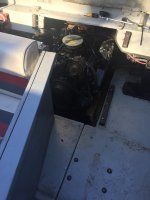
I still got 2 of them, @Scott Danforthhey you can always drop the 3.7 back in ...
antifreeze coolant 50%-distilled water 50% engine! yes!Even if I did pull the boat from the water, how do I get the water out of the block?
Hey Roy, his boat is still in the water. you cant winterize with the boat in the water as the waterline is above the motorantifreeze coolant 50%-distilled water 50% engine! yes!

Ayuh,..... That's the Theory,.....To me, this indicates that the block water is drained through these hoses so freezing shouldn't be an issue.
sorry water delay. engine.sorry for the delay - I thought I sent this a week ago. Thank you.