I/O (Sterndrive) Conversion to Outboards

jlh3rd

Ensign
Joined
Jul 10, 2017
Messages
955
I made sausage biscuits and cracked open another bottle of gin. In the south, we just wait a day ot two. Much easier. Couple three naps a day.
in our borough, we are supposed to clear sidewalks 12 hrs after the "event". It use to be 24 hrs. This is BS of course. Typical "white tower" overreach.
Who/What determines the "end of event" ? And what does "clear" mean?
 

tpenfield

Moderator
Staff member
Joined
Jul 18, 2011
Messages
18,895
Quick Update . . .

I had a follow-up call with the Naval Architect yesterday. He is going to run a speed/power analysis on the new hull configuration, given that there will be 42" of additional planing surface.

We've had some discussion on the transom, as he indicated the need for a solid core in the areas of the engine mounts (G10 material, which is epoxy-based). I had some concerns about epoxy vs. VE as well as the need for a solid core vs. the Coosa as the core.

After discussion, the light bulb went on . . . 💡 . . . The combination of the clamping force of the engine bracket and usage over time will tend to depress the core, if it were a 'softer' material, and weaken the overall lamination. It's a longevity thing. (OK, I get it (y) :D ) . . . the Coosa is much 'softer' than the fiberglass.
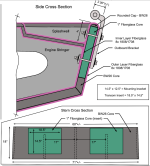
G10 is wicked pricey, ($650-ish for what I would need) and not entirely friendly with the VE resin, but the N.A. suggested that I could make the core if need be.

So here is the plan . . .
.
Transom-Core-pic.png
.
I'll cut out the 2 'engine mount' areas in the Coosa board and 'fill' the voids with fiberglass . . . probably will use some vacuum-assist to get a good density of glass. Then the entire transom will get more glass to build it up to a desired thickness. . . and even more glass for installation.

Works in theory . . . :ROFLMAO:
 

tpenfield

Moderator
Staff member
Joined
Jul 18, 2011
Messages
18,895
Ask him about Aqua Steel
I did . . . (not familiar with it). A lot of these materials (Aqua-Steel, Whalelite) are more direct to manufacturer type of sales/distribution. G-10, GPO-3 and a few others seem to have a wider use-base and can be found at more suppliers.
 

tpenfield

Moderator
Staff member
Joined
Jul 18, 2011
Messages
18,895
I will ask the NA at work on Monday. He is the one that suggested Aquasteel with VE
No worries. I am good with making the fiberglass core as I described. I got enough extra glass and resin to make a decent core . . . and it will bond itself to the Coosa.
 

tpenfield

Moderator
Staff member
Joined
Jul 18, 2011
Messages
18,895
Going to be great
Maybe why builders like Formula just buy the brackets from Armstrong
I like how Formula does their OB versions . . . they extend the hull/planing surface out to where the swim deck ends, then go with a bracket from there.

I'm not a fan of their swim deck with OB's . . . at least on the 310-330 series. I think on the bigger boats the swim platform area is more thought out.
 

tpenfield

Moderator
Staff member
Joined
Jul 18, 2011
Messages
18,895
On to the Transom . . .

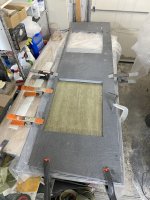
I cut out the two areas for the fiberglass insert. My plan is to glass one side of the cavities and then 'fill' the cavities with a glass/resin combination to be level with the open side.

Here is the glass layer of 1808 setting up on one of the cavities.
.
IMG_9143.JPG
.
There is a 1" thick Coosa board (and plastic barrier) clamped underneath to keep it all nice and flat.
 
Last edited:

tpenfield

Moderator
Staff member
Joined
Jul 18, 2011
Messages
18,895
In other news . . .

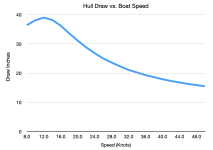
I got the Hydrostatic & Speed/Power (Savitsky) analysis back from the N.A.

Not 100% sure what I'm looking at, but overall it looks good. I'll be having a follow-up call with the N.A. over the next few days.

In summary . . .
  • No adverse trim effects from the added stern buoyancy & planing surface.
  • Estimated speed is 52+ MPH with twin 300 hp engines. (the current boat does/did 45 mph).
  • Loads are as predicted and in accordance with the design.
 

tpenfield

Moderator
Staff member
Joined
Jul 18, 2011
Messages
18,895
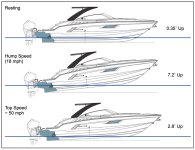
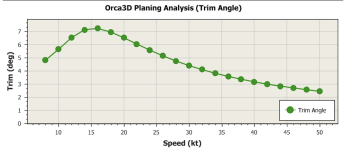
One thing that the N.A. was interested in reviewing, given the added buoyancy at the stern, was the trim angle of the hull. If the trim becomes 'negative', then the boat would tend to 'plow' at first when coming up on plane. . . not the best thing to have and would require compensating with engine trim, etc.

The analysis showed that while the stern may raise up a 'wee bit' from its original attitude, it still maintains a slightly positive trim angle. (a good thing)

Coming up on plane, the 'hump' angle is predicted to be about 7.2˚ . I'm not sure what the hump angle has been with the sterndrives, but it was a lot.

Here is a set of trim angle diagrams I put together, based on the analysis . . .
.
Trim-Angles.png
.
I was interested in having the hydro-static and speed/power analyses done to see if there were any detrimental concerns of the design. Overall, things look OK.
 
Last edited:
Top